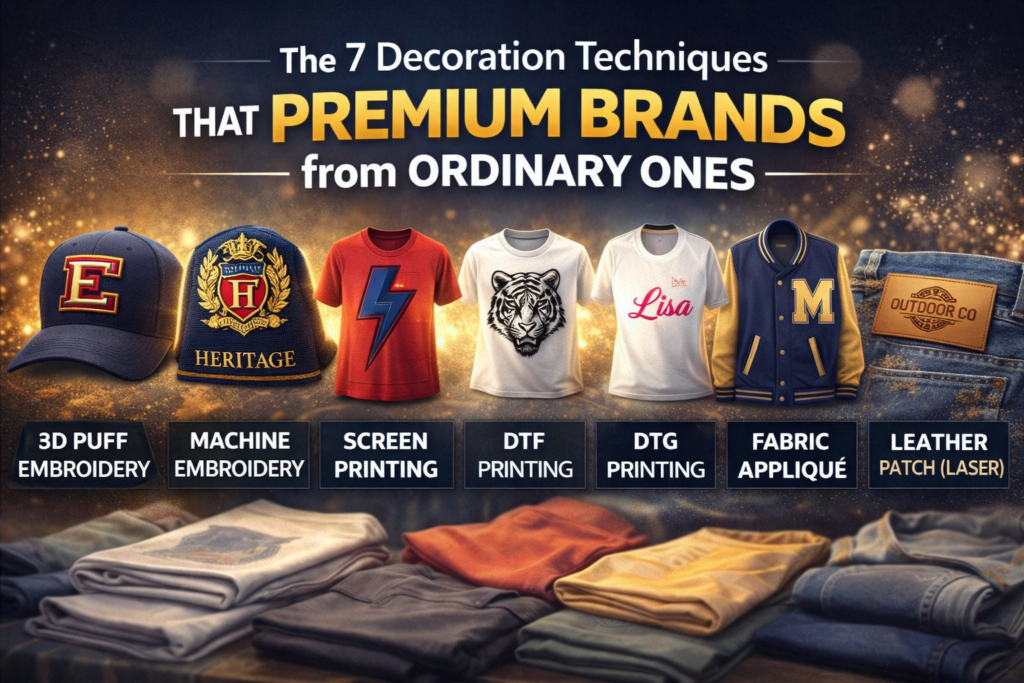
That embroidered logo. The raised lettering on the chest. The way that leather patch feels when you run your thumb across it. Premium brands are not just better-made — they are better-decorated. Here is the exact playbook they use.
Walk into any streetwear store in Mumbai, Tokyo, or New York and pick up two T-shirts. Both made from 100% cotton. Both the same weight. Both priced at roughly the same retail point. Yet one feels like a brand. The other feels like a shirt.
What is the difference? Almost always, it comes down to how the garment was decorated — the graphic treatment, the embroidery placement, the finish on the hardware. These are the details that tell a customer: this brand knows what it is doing.
As a brand owner, choosing the right decoration technique is one of the most important decisions you will make before production begins. Here is a complete breakdown of the seven techniques available — what each one does, when to use it, and the type of brand it is best suited for.
Technique 01
3D Puff Embroidery — The Statement Maker
If you want your logo to command attention the moment someone looks at it, 3D puff embroidery is the technique. A foam underlayer is placed beneath the embroidery thread, creating raised, three-dimensional lettering or shapes that literally stand off the fabric.
Best for: Caps and headwear, streetwear brands, sports labels, and any brand that wants maximum visual impact on chest logos.
Technique 02
Machine Embroidery — The Classic Workhorse
Flat machine embroidery is the gold standard for logos, crests, and patches. Thread is stitched directly into the fabric in intricate patterns, creating a tactile, premium finish that does not crack, fade, or peel even after hundreds of washes.
Best for: Heritage brands, luxury casualwear, polos, and any garment where durability and brand equity matter most.
Technique 03
Screen Printing — The Bold, High-Volume Choice
Screen printing pushes ink through a mesh stencil directly onto fabric. The result is vibrant, opaque colour with a soft hand feel. It is the technique behind virtually every iconic band tee, streetwear drop, and graphic-heavy collection.
Best for: Graphic tees, bold brand statements, runs of 50+ units, and brands focused on visual impact.
Technique 04
Direct-to-Film (DTF) — The Detail Master
Direct-to-Film printing transfers a full-colour graphic from a film sheet onto the garment using heat. Modern DTF reproduces photographic detail, gradients, and complex artwork that screen printing simply cannot match.
Best for: Small runs with complex artwork, photographic prints, limited-edition drops, and any print requiring high colour fidelity.
Technique 05
Direct-to-Garment (DTG) — The On-Demand Solution
Direct-to-Garment printing works like an inkjet printer for fabric. Ink is sprayed directly into the fibres, creating a finish that feels almost like part of the fabric itself rather than sitting on top of it.
Best for: Personalised products, one-off samples, print-on-demand brands, and soft-feel all-over prints on light-coloured garments.
Technique 06
Fabric Appliqué — The Textural Touch
Appliqué involves cutting a shape from one fabric and stitching it onto the garment — often reinforced with embroidery around the edges. The result is a three-dimensional, multi-textural element that no print technique can replicate.
Best for: Heritage varsity aesthetics, kids wear, premium sportswear, and brands that want a handcrafted, artisanal feel.
Technique 07
Laser-Engraved Leather Patches — The Luxury Detail
A laser burns your brand’s logo or text directly into genuine or vegan leather, creating a permanent, tactile mark that only looks better with age. The decoration technique most associated with heritage denim brands, premium caps, and luxury casual wear.
Best for: Premium caps, jeans, jackets, and any brand positioning itself at the luxury or semi-luxury tier.
Quick Reference: Which Technique is Right for You?
Use this table as a cheat sheet before your first production conversation:
| Technique | Best Used For | Brand Type |
|---|---|---|
| 3D Puff Embroidery | Caps, chest logos, bold statements | Streetwear, sports, lifestyle |
| Machine Embroidery | Logos, crests, long-lasting detail | Heritage, luxury casual, corporate |
| Screen Printing | Bold graphics, high-volume runs | Streetwear, events, graphic brands |
| DTF Printing | Complex artwork, small batches | Limited-edition drops, D2C brands |
| DTG Printing | Personalisation, soft-feel prints | Print-on-demand, custom gifting |
| Fabric Appliqué | Textural logos, layered designs | Kids wear, varsity, premium sport |
| Leather Patch (Laser) | Premium branding details | Luxury, heritage, denim labels |
The Most Powerful Choice: Combining Techniques
The brands that truly stand out almost always use a combination of techniques on a single garment. A cap might have 3D puff embroidery on the front panel, a laser-engraved leather patch on the back, and a woven label inside. A premium hoodie might carry chest machine embroidery alongside a DTF sleeve print.
Your decoration choices are your brand’s first physical handshake with your customer. Make sure it says exactly what you want it to.
Want to see all 7 techniques applied to your brand?
Umora Fashion offers all seven decoration techniques in-house, with zero minimum order requirement. From your first sample to your full production run, we handle everything from fibre to finished product — Navi Mumbai, India. 4th generation, 20+ years of expertise.
